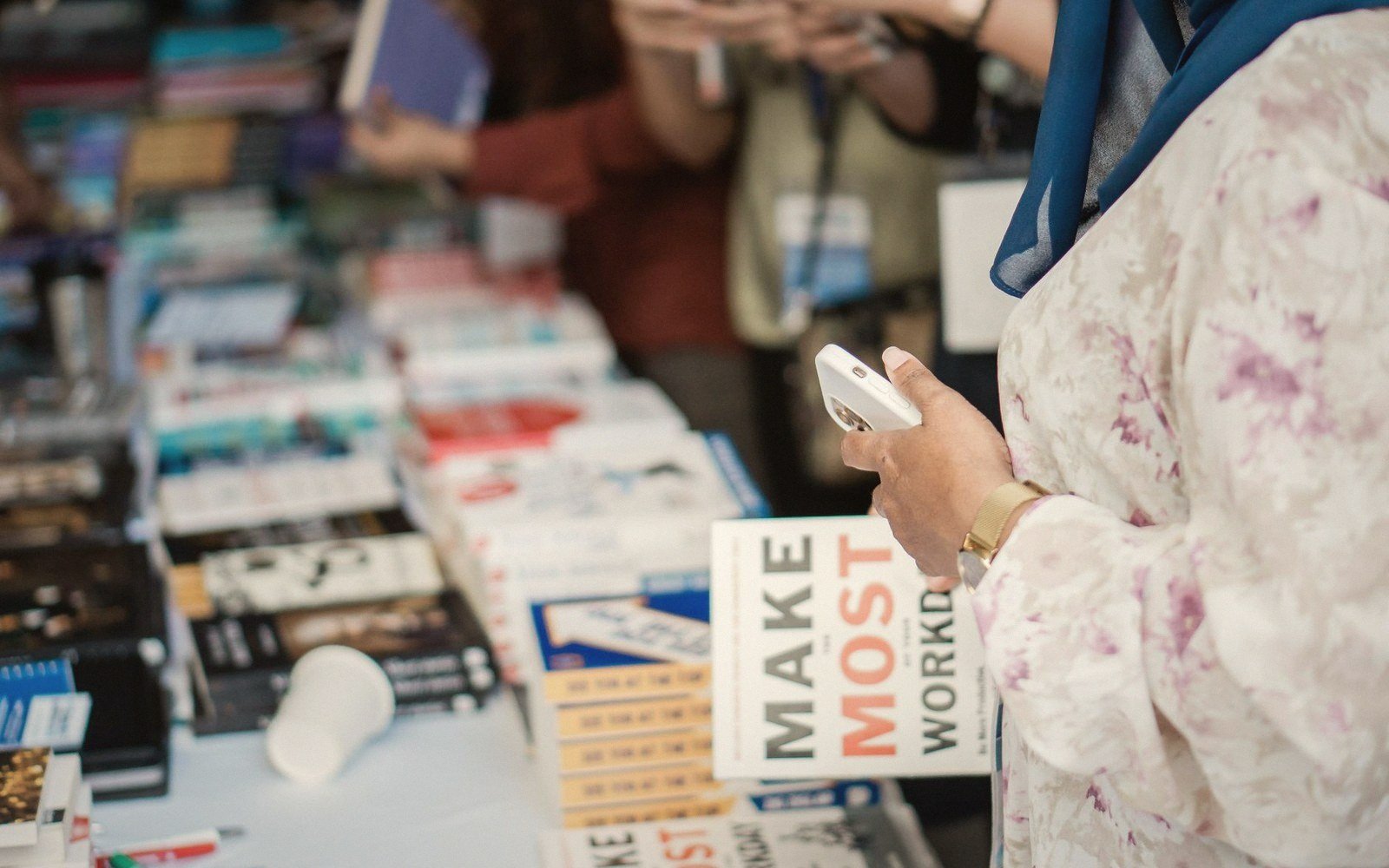
A book's life in its original language is only one version of its journey. The machinery that decides which books cross borders — and which stay home — runs on agents, agents' agents, and a few overcrowded hotel lobbies.
The Fair and Its Logic
Several times a year, a significant portion of the international publishing industry converges on the same few cities. The Frankfurt Book Fair, held each October, is the larger and older event — a trade fair at which rights, not books, are the principal commodity. Bologna, in spring, focuses on children's publishing. London, in March, occupies a middle ground. At each, publishers and agents from different territories sit across narrow tables and negotiate whether a book that exists in one language will be made to exist in another.
The conversation that happens at these fairs is usually quite short. An agent presents a book — sometimes a published one, sometimes a manuscript, sometimes only a proposal — and a foreign publisher or a foreign rights agent asks who else is interested, what the world rights situation looks like, and how the book has performed or is expected to perform at home. If the interest is mutual, an option fee is paid and a formal offer follows. If it is not, the meeting ends politely and the next one begins. A successful agent at Frankfurt will take thirty or forty such meetings in four days. Most of them lead nowhere.
What makes a book travel is only partly the book itself. The reputation of the original publisher matters: a novel from an established literary house arrives with a kind of institutional endorsement that a debut from a smaller press lacks, regardless of quality. The advance a book has commanded in its home market matters, because a high acquisition cost signals to foreign buyers that someone with skin in the game has already bet on this title. Translation history matters too — a French novel that has sold into German and Spanish is demonstrably easier to pitch into Polish than one that has sold into nothing, because the category of "international" is self-reinforcing. Each sale makes the next sale marginally easier.
Subagents, Co-agents, and the Invisible Infrastructure
Most literary agents do not personally conduct rights negotiations in every market. Instead, they work through a network of co-agents or subagents — specialists in particular territories who know the local publishers, speak the local language, and understand which houses are currently acquiring which kinds of work. An author in France whose agent is in Paris may have a subagent in New York handling North American rights, a different subagent in London for the UK, and a further network covering Scandinavia, Japan, Korea, and Brazil. Each subagent takes a commission on any deal they close, and that commission comes out of the author's share. The infrastructure is real, efficient, and expensive.
This network means that a book with a well-connected agent enters the international market with a degree of pre-existing visibility. A book without one — or with an agent who lacks foreign co-agent relationships — enters it barely at all. Many books published in smaller languages, or by publishers too small to attend Frankfurt themselves, simply do not circulate in this system. They exist, and they are sometimes excellent, but they are invisible to the buyers who would be capable of acquiring them.
Why Comparable Books Travel Differently
The quality gap between a book that sells into twenty languages and one that sells into none is frequently small, and sometimes nonexistent. What differs, almost always, is the position of the book in the market infrastructure at the moment of its release. A novel published in a major language by a house with strong international relationships, agented by someone who attends the fairs and maintains co-agent networks, published in a season when buyers are paying attention: that book is playing a different game to a novel of identical literary merit that arrives at the market without any of those structural advantages.
Advance structures reflect and amplify this asymmetry. In a bidding situation — where multiple foreign publishers want the same title — advances rise quickly, and those rising numbers generate further coverage, further interest, and further sales. The winner's-curse dynamic is real: some of the most aggressively acquired books of any season are acquired precisely because they are being aggressively acquired, the competitive logic overwhelming any sober assessment of actual literary or commercial fit. Meanwhile, a quieter book with no auction and no buzz may find a single foreign buyer who happens to love it, or none.
Key events in the calendar
- Frankfurt Book Fair (October)the dominant world rights market, all adult trade categories
- London Book Fair (March)significant for English-language and co-edition deals
- Bologna Children's Book Fair (April)the principal market for children's and illustrated publishing
- Bologna is spring, Frankfurt is autumnthe rhythm shapes when deals close and when they translate into publication
Translation itself introduces further friction. Even a foreign publisher who wants a book must find a translator, schedule the translation into a list, and absorb the cost — and in most territories, translating literary fiction is a slow and modestly funded enterprise. A book that would translate elegantly and cheaply into a cognate language faces fewer barriers than one whose style is rooted in linguistic effects that resist transit. The decisions a translator makes before the first word is set down are already shaped by what a publisher was willing to pay for the right to set them down at all.
The rights fair, then, is not a talent competition. It is a market for attention — for the kind of institutional alignment that gives a book the chance to be read in a language its author never imagined. The books that travel are mostly the books that were positioned to travel. The rest stay home.